


This site contains affiliate links. I may earn a commission if you purchase through these links. Thank you for being so supportive!
Did you know the average American spends $1,100 on coffee yearly? I used to be one of them—until I learned to brew exceptional coffee at home.
I grew up in Peru’s coffee country, where I watched my family work with coffee farmers and learned what separates truly great coffee from mediocre brews.
After moving to NYC and helping specialty coffee shops perfect their offerings, I realized most people waste money on bad coffee when they could make better at home for pennies per cup.
Here’s the truth: You don’t need a $2,000 espresso machine to brew exceptional coffee at home. You need fresh beans, the right technique, and about $100 in basic equipment.
In this guide, I’ll show you exactly how I brew coffee that rivals $6 cafe drinks, using methods I’ve tested for years and taught to hundreds of home brewers. No fluff, no fancy jargon, just what actually works.
How Do You Brew Exceptional Coffee at Home?
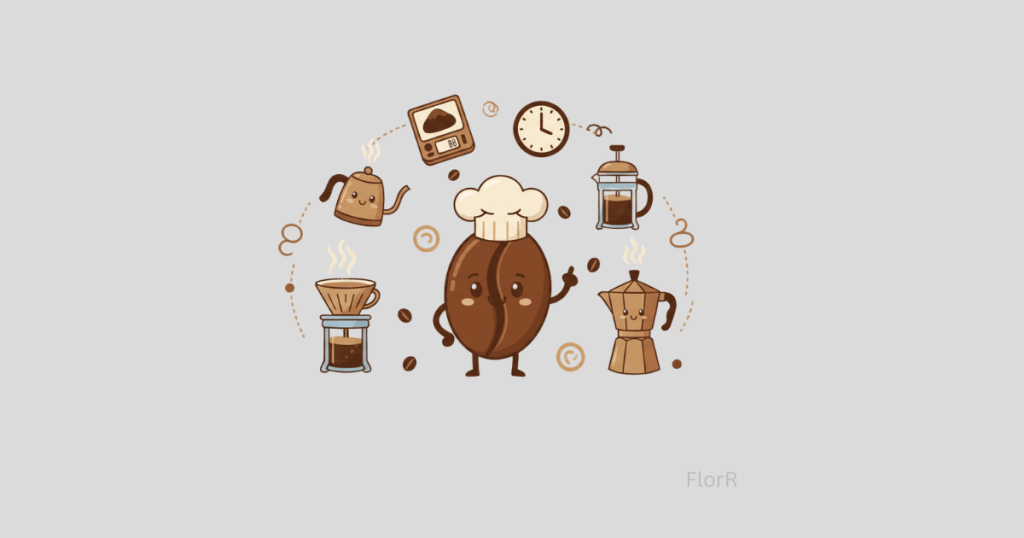
To brew exceptional coffee at home, follow these 5 essential steps:
- Use fresh, quality beans – Buy whole beans roasted within the last 2-3 weeks
- Grind right before brewing – Match grind size to your brewing method
- Use proper water – Filtered water at 195-205°F (90-96°C)
- Measure accurately – 1:16 coffee-to-water ratio (15g coffee per 240ml water)
- Choose your method – French press, pour-over, or AeroPress for beginners
The most important factor? Fresh beans and proper grind size make the biggest difference.
Time required: 5-10 minutes
Cost to start: $50-100
Savings: $125+ monthly vs daily coffee shops
The 5-Minute Method: Your First Perfect Cup
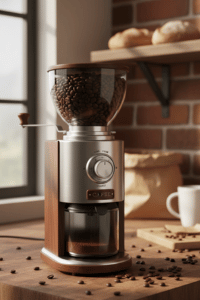
COFFEE GRINDER
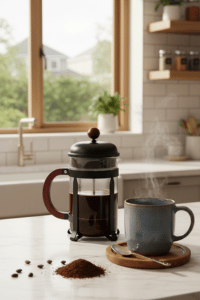
FRENCH PRESS
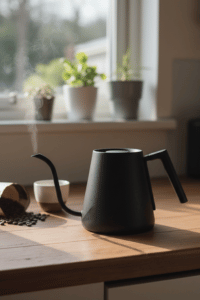
gooseneck kettle
Before we dive deep, let me show you how to brew exceptional coffee at home right now, even if you’ve never done it before.
Total time: 5 minutes
Equipment: French press, grinder, scale, kettle
Skill level: Complete beginner
Cost per cup: $0.40
The Steps
- Measure (30 seconds): 30g whole beans, 500ml filtered water
- Grind (30 seconds): Coarse like sea salt, right before brewing
- Heat water (2 minutes): Boil and let cool 30 seconds (200°F ideal)
- Brew (4 minutes): Add coffee, pour water, stir, lid on (don’t press), wait exactly 4 minutes
- Press and serve (30 seconds): Press slowly, pour immediately, enjoy
Pro tip: If it tastes bitter, use coarser grind or less time. If sour or weak, use finer grind or more time.
You just made your first exceptional cup. Now let’s understand why it works.
The Foundation: Selecting Perfect Beans
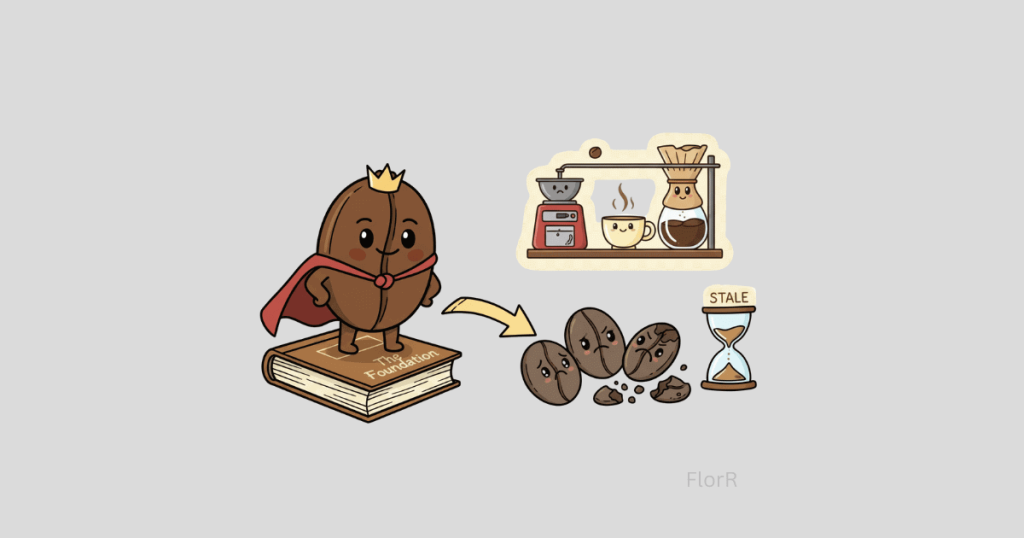
The most important decision when learning to brew exceptional coffee at home is choosing your beans. Everything else can’t fix bad, stale coffee.
Coffee Origins: Where Flavor Begins
Different regions produce distinctly different flavors.
African Coffees (Ethiopia, Kenya):
- Taste: Bright, fruity, floral
- Notes: Berries, citrus, jasmine
- Choose if: You like tea or fruity flavors
South American Coffees (Colombia, Brazil, Peru):
- Taste: Balanced, sweet, nutty
- Notes: Chocolate, caramel, nuts
- Choose if: You want classic, approachable coffee
Central American Coffees (Guatemala, Costa Rica):
- Taste: Clean, crisp, sweet
- Notes: Apple, honey, citrus
- Choose if: You like balanced flavors
Asian Coffees (Sumatra, Indonesia):
- Taste: Bold, earthy, heavy
- Notes: Herbs, dark chocolate, spice
- Choose if: You like strong, bold coffee
Quick rule: African = fruity and bright, South American = balanced and sweet, Asian = bold and earthy.
Explore more in my complete guide on coffee bean origins.
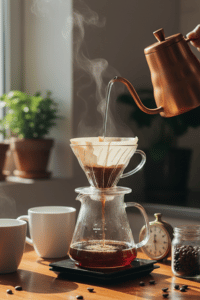
V60 Coffee Maker
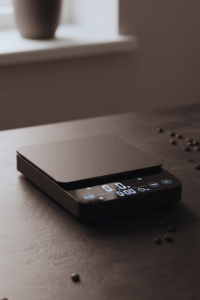
COFFEE SCALE
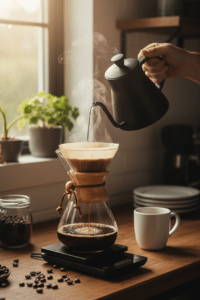
CHEMEX
Roast Levels Simplified
Light Roast: Bright, acidic, complex, fruity, choose if you appreciate subtlety
Medium Roast: Sweet, balanced, approachable, best for beginners
Dark Roast: Chocolate, smoky, low acidity, choose if you like strong coffee or add milk
The myth: Dark roast doesn’t have more caffeine. Light roast has slightly more.
Learn more about understanding coffee roast levels.
Freshness: The Non-Negotiable Factor
Coffee goes stale. This is critical when you brew exceptional coffee at home.
The timeline:
- Week 1-2 after roasting: Peak flavor
- Week 3-4: Still good, declining
- Week 5+: Noticeably stale
- Month 3+: Tastes like cardboard
What to look for:
- ✅ Roast date printed clearly
- ✅ Whole beans (not pre-ground)
- ✅ One-way valve on bag
- ✅ Local roaster or specialty shop
What to avoid:
- ❌ “Best by” date instead of roast date
- ❌ Pre-ground coffee (loses 60% flavor in 15 minutes)
- ❌ Grocery store bulk bins
- ❌ No date at all
Pro tip: Buy small quantities (8-12 oz) every 2-3 weeks rather than bulk purchasing.
Understanding how to read coffee labels helps you identify truly fresh beans.
Essential Equipment (Under $100 Total)
You don’t need expensive equipment to brew exceptional coffee at home. You need the right basics.
COFFEE GRINDER
FRECH PRESS
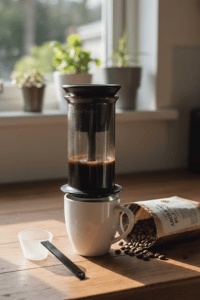
AEROPRESS
The Core Four
1. Coffee Grinder ($30-80)
- Burr grinder: More consistent ($40-80)
- Blade grinder: Budget option ($20-30)
- Recommendation: Hario Mini Mill or Porlex hand grinder
2. Brewing Device ($15-40)
- French Press: Best for beginners ($20-30)
- Pour-Over: Clean taste, needs practice ($30-40)
- AeroPress: Versatile, travel-friendly ($30)
3. Kitchen Scale ($15-25)
- Any digital scale measuring to 0.1g
- Essential for consistency
4. Gooseneck Kettle ($20-50)
- Controlled pouring, proper temperature
- Budget: Regular kettle works for French press
Total investment: $50-100 for quality basics.
If you’re interested in espresso, read my guide on choosing the perfect home espresso machine.
Brewing Methods Comparison
| Method | Time | Difficulty | Taste | Best For | Cost |
|---|---|---|---|---|---|
| French Press | 4-5 min | Easy | Full-bodied, rich | Beginners | $20-30 |
| Pour-Over | 3-4 min | Medium | Clean, bright | Enthusiasts | $30-60 |
| AeroPress | 2-3 min | Easy | Versatile, smooth | Travelers | $30 |
| Cold Brew | 12-24 hrs | Easy | Smooth, low-acid | Iced coffee | $20-30 |
| Espresso | 25-30 sec | Hard | Strong, concentrated | Latte lovers | $200+ |
Recommendation: Start with French press for easy, full-flavored coffee. Choose pour-over if you enjoy the brewing ritual.
Water: Your Brew’s Secret Ingredient
Water is 98% of your coffee. Most people ignore this when learning to brew exceptional coffee at home.
Water Quality
Use:
- ✅ Filtered tap water
- ✅ Bottled spring water
- ✅ Water that tastes good to drink
Avoid:
- ❌ Distilled water (too pure, lacks minerals)
- ❌ Heavily chlorinated tap water
- ❌ Softened water
Temperature: The Goldilocks Zone
Target: 195-205°F (90-96°C)
Easy method without thermometer:
- Bring water to full boil
- Remove from heat
- Wait 30 seconds
- Pour (now at ~200°F)
Coffee-to-Water Ratio
The golden ratio: 1:16 (1 gram coffee to 16 grams water)
In practical terms:
- 15g coffee : 240ml water = 1 cup
- 30g coffee : 480ml water = 2 cups
- 60g coffee : 960ml water = 4 cups
Adjust to taste:
- Stronger: 1:15
- Standard: 1:16
- Milder: 1:17
Mastering the Grind
Grind size controls extraction speed. Wrong grind ruins everything.
Burr Coffee Grinder for Fresh, Consistent Home Brewing
This burr coffee grinder delivers consistent, even grounds for better-tasting coffee. Adjustable settings make it easy to grind for espresso, drip, pour-over, or French press. Freshly ground beans mean fuller flavor, smoother extraction, and a better cup every time.
Grind Sizes for Different Methods
Extra Coarse: Cold brew (12-24 hours)
Coarse (sea salt): French press (4-5 minutes)
Medium-Coarse: Chemex (3-4 minutes)
Medium (regular sand): Pour-over, drip (2-3 minutes)
Medium-Fine: AeroPress (1-2 minutes)
Fine (sugar): Espresso (25-30 seconds)
Extra Fine: Turkish coffee (seconds)
Quick rule: Longer brew time = coarser grind. Shorter brew time = finer grind.
Burr vs Blade Grinders
Burr Grinders (Better):
- Consistent particle size
- Adjustable settings
- Better flavor extraction
- Cost: $40-300+
Blade Grinders (Budget):
- Inconsistent particle size
- “Good enough” results
- Cost: $15-30
My honest take: If you’re serious about learning to brew exceptional coffee at home, save for a basic burr grinder ($40-50). But a blade grinder beats pre-ground coffee.
French Press: Best Way to Start
French press is my recommended method for anyone learning to brew exceptional coffee at home.
French Press Coffee Maker for Rich, Full-Bodied Brews
This French press brews smooth, bold coffee with deep flavor and natural oils intact. Simple to use and easy to clean, it delivers a rich cup without filters or complicated steps—just fresh grounds, hot water, and great coffee at home.
The Classic Method
Ratio: 1:15 (30g coffee : 450ml water)
Steps:
- Preheat French press, discard water
- Add coarse ground coffee
- Start timer, pour all hot water
- Stir gently 10 seconds
- Lid on (don’t press yet)
- Wait exactly 4 minutes
- Press slowly 20-30 seconds
- Pour immediately
Common problems:
Gritty: Use coarser grind, don’t press to bottom
Weak: Use more coffee (1:14), increase time to 5 minutes
Bitter: Reduce time to 3 minutes, use coarser grind
French press also makes incredible cold brew—use room temperature water and steep 12-18 hours in fridge.
Pour-Over: For the Enthusiast
Pour-over gives you complete control to brew exceptional coffee at home with clean, nuanced flavors.
The V60 Method
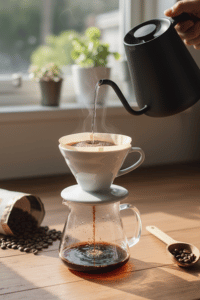
V60 Pour-Over Coffee Method for Clarity and Precision
The V60 method delivers a clean, vibrant cup with full control over flavor. Its cone shape and spiral ribs promote even extraction, highlighting delicate notes and natural sweetness. Ideal for light to medium roasts, this method rewards precision with a bright, balanced brew every time..
Ratio: 1:16 (15g coffee : 240ml water)
Steps:
- Place filter in V60, rinse with hot water
- Discard rinse water, add coffee
- Bloom: Pour 30g water in circles, wait 30 seconds
- First pour: Slowly pour to 120g total (45 seconds)
- Second pour: Pour to 240g total (another 45 seconds)
- Total brew time: 2:30-3:00 minutes
- Enjoy immediately
Pouring technique:
- Start in center, pour in concentric circles
- Don’t pour directly on filter
- Keep steady, consistent flow
AeroPress: Quick and Versatile
AeroPress is perfect for travelers and experimenters learning to brew exceptional coffee at home.
AeroPress Coffee Method for Smooth, Low-Acid Brews
The AeroPress brews rich, smooth coffee in minutes using gentle pressure and full immersion. It reduces bitterness while enhancing sweetness and body, making it ideal for clean, balanced cups at home or on the go.
Standard Method
Ratio: 1:13 (17g coffee : 220g water)
Steps:
- Insert filter, rinse with hot water
- Place AeroPress on mug, add coffee
- Pour all water, stir 10 seconds
- Insert plunger, pull up slightly
- Wait 1 minute
- Press slowly over 30 seconds
- Dilute with hot water if too strong
AeroPress makes concentrated coffee perfect for “espresso-style” drinks. Add hot water for an Americano or steamed milk for a latte.
Cold Brew: Smooth and Refreshing
Cold brew is the easiest way to brew exceptional coffee at home in large batches.
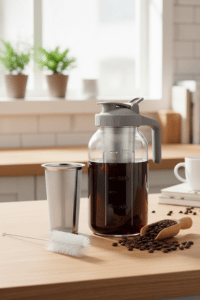
Cold Brew Coffee Maker for Smooth, Naturally Sweet Coffee
This cold brew coffee maker produces smooth, low-acid coffee with a naturally sweet taste. Designed for slow extraction, it delivers bold flavor without bitterness—perfect for refreshing iced coffee at home.
Simple Method
Ratio: 1:5 for concentrate (100g coffee : 500ml water)
Steps:
- Combine coarse coffee and cold water
- Stir to fully saturate
- Cover and refrigerate 12-18 hours
- Strain through filter or French press
- Dilute concentrate 1:1 with water or milk
- Store in fridge up to 2 weeks
Variations:
- Vanilla: Add vanilla extract
- Coconut: Dilute with coconut water
- Tonic: Mix with tonic water and orange
Read the full comparison at espresso vs cold brew.
Common Mistakes to Avoid
Mistake #1: Using Stale Beans
Bad: Buying pre-ground coffee from grocery stores
Good: Buying whole beans with roast date, using within 3 weeks
Mistake #2: Wrong Grind Size
Bad: Using same grind for all methods
Good: Coarse for French press, medium for pour-over, fine for espresso
Mistake #3: Guessing Measurements
Bad: Eyeballing coffee and water amounts
Good: Using kitchen scale for consistency
Mistake #4: Boiling Water
Bad: Pouring actively boiling water (212°F) onto coffee
Good: Letting water cool 30 seconds after boiling (195-205°F)
Mistake #5: Dirty Equipment
Bad: Never cleaning your grinder or brewing equipment
Good: Washing equipment after each use, deep cleaning weekly
The #1 mistake? Trying to brew exceptional coffee at home with stale beans. Everything starts with freshness.
Real Cost Breakdown
Can you actually save by learning to brew exceptional coffee at home?
Coffee Shop Habit (Daily Latte)
Cost per drink: $5
Monthly cost: $150
Annual cost: $1,825
Home Brewing (Same Quality)
Initial equipment (one-time): $105
- French press: $25
- Burr grinder: $50
- Kitchen scale: $15
- Kettle: $15
Monthly ongoing: $33
- Quality beans: $30
- Filters: $3
Annual cost:
- First year: $501
- Years 2+: $396
The Savings
First year savings: $1,324
Every year after: $1,429
Break-even point: 21 days
Cost per home cup: $0.40-0.60 vs $5.00 at coffee shops
The math is clear. Learning to brew exceptional coffee at home pays for itself within a month and saves over $1,400 annually.
Final Thoughts
Congratulations, you now know exactly how to brew exceptional coffee at home.
The journey from coffee shop regular to home brewing expert isn’t about perfection. It’s about progress. Start simple: French press, fresh beans, basic measurements. Master that before moving to more complex methods.
Remember these three things:
- Fresh beans beat everything – This matters more than any equipment
- Measure for consistency – You can’t improve what you don’t measure
- Experiment and adjust – Your perfect cup is personal
The best cup of coffee is the one you enjoy. Don’t let coffee snobs tell you you’re doing it wrong if you like what you’re drinking.
Your next steps:
This week, buy fresh whole beans with a visible roast date. Grind them right before brewing. Use a scale to measure your coffee and water. That’s it.
Next week, try adjusting your brew time or grind size. Notice how it changes the flavor. Keep what works, change what doesn’t.
Within a month, you’ll brew exceptional coffee at home that rivals anything you’d pay $5 for at a cafe. And you’ll save over $100 monthly doing it.
Need more guidance? I’ve written detailed guides on choosing coffee beans, reading coffee labels, and coffee roast levels to help you continue your journey.
Now go brew something delicious. Your perfect cup is waiting.
Frequently Asked Questions
How do you make really good coffee at home?
Start with fresh whole beans roasted within 2-3 weeks. Grind them right before brewing using the correct grind size for your method.
Use filtered water heated to 195-205°F and maintain a 1:16 coffee-to-water ratio. The French press is easiest for beginners to brew exceptional coffee at home.
What is the secret to making the best coffee?
The secret is freshness. Buy whole beans in small quantities, store them in an airtight container away from light and heat, and grind only what you need right before brewing. Fresh beans make more difference than expensive equipment.
Can you make coffee at home as good as coffee shops?
Yes, absolutely. Home-brewed coffee often tastes better because you control freshness, bean quality, grind size, and brewing method. A $30 French press and fresh beans frequently produce superior coffee to chain shops using old beans.
What is the easiest way to brew coffee at home?
French press is the easiest method to brew exceptional coffee at home for beginners. It’s forgiving, requires minimal technique, works with various grind sizes, makes consistently great coffee, and costs under $30.
How much coffee do I use per cup?
Use 15-18 grams of coffee (about 2 tablespoons) for every 8 ounces (240ml) of water. This creates a 1:16 ratio. Adjust to taste—more coffee for stronger brew, less for milder.
Why does my homemade coffee taste bitter?
Bitter coffee usually means over-extraction. Fix it by using coarser grounds, shorter brew time, or cooler water (195-205°F not boiling). Also check your beans—old, stale coffee tastes bitter regardless of method.
How long do coffee beans stay fresh?
Whole coffee beans stay fresh for 2-3 weeks after roasting when stored properly in an airtight container away from light, heat, and moisture. Ground coffee loses freshness within days. Buy small quantities frequently.


