The best commercial coffee grinders for small coffee shops in 2026 are the Nuova Simonelli MDXS Digit ($1,850), Eureka Helios 75 ($1,399), and Nuova Simonelli MDXS ($1,350).
Which one you should buy depends on your daily shot volume, how much dosing control your baristas need, and what you can realistically budget alongside your espresso machine.
I’ve walked through 150+ coffee shops from NYC to Portland. I’ve seen every mistake: owners who pair a $12,000 espresso machine with a $300 grinder and wonder why their shots taste flat.
And I’ve seen $1,400 grinders outlast machines twice their price because the owner chose wisely and maintained them properly.
Here’s what nobody tells you: your grinder matters as much as your espresso machine, maybe more. Inconsistent grind size = inconsistent extraction = wasted coffee, unhappy baristas, and customers who don’t come back.
Before buying any grinder, make sure it fits into your complete equipment budget. Check the full essential equipment list for coffee shop startups to see where grinders belong in the bigger picture.
“Feeling overwhelmed by the paperwork? Let’s work together on your NYC coffee shop marketing so you can focus on opening your doors.”
Explore the coffee directory
Want to see how real coffee shops turn these strategies into sales?
Quick Comparison: Best Commercial Coffee Grinders
| Grinder | Price | Burrs | Dosing | Best For |
|---|---|---|---|---|
| Nuova Simonelli MDXS Digit | $1,850 Aprox | 75mm flat | Digital programmable | Best overall |
| Eureka Helios 75 | $1,399 Aprox | 75mm flat | Touchscreen programmable | Best value |
| Nuova Simonelli MDXS | $1,350 Aprox | 75mm flat | On-demand | Budget commercial |
| Baratza Forte AP | $850 Aprox | 54mm ceramic | Time + weight | Decaf / backup |
| TIMEMORE Sculptor 078S | $800 Aprox | 78mm flat | Stepless | Specialty / low volume |
| Fiorenzato AllGround Sense | $1,250 Aprox | — | Electronic | Residential — see note |
How to Pick Your Commercial Coffee Grinder
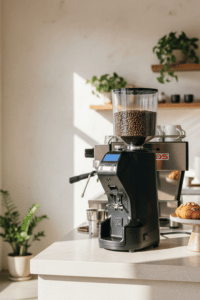
Nuova Simonelli MDXS Digit Coffee Grinder – Commercial Espresso Grinder
The Nuova Simonelli MDXS Digit coffee grinder is a commercial espresso grinder designed for precision and consistency. Featuring a digital display and a large bean hopper, this grinder is ideal for coffee shops that require fast, accurate dosing and reliable performance for high-volume espresso service. Its sleek, professional design makes it a strong addition to any modern café setup.
Match Burrs to Your Volume
Burr diameter drives heat management. Bigger burrs = slower heat buildup = more consistent grind over a long rush.
- Under 150 shots/day: 54mm flat burrs work fine
- 150-300 shots/day: 75mm flat burrs (where most small cafes need to be)
- 300+ shots/day: 75mm+ with high-duty motor and programmable dosing
Don’t cheap out on burr size. A small burr grinder doing 250 shots a day will overheat, the grind will drift, and your last shot of the morning rush will taste nothing like your first.
I cover the full grinder-to-machine pairing in The best commercial espresso machines for small coffee shops
Timed vs Programmable vs Gravimetric Dosing
- Timed dosing: Grinds for set seconds. Simple, requires recalibration when you switch coffee bags.
- Programmable digital dosing: Stores dose presets. Faster for multi-barista bars, more repeatable across shifts.
- Gravimetric (weight-based): Grinds to an exact weight every time. Most accurate, reduces waste, easiest for training new staff.
For a busy cafe doing 200+ shots, programmable dosing pays for itself in barista time savings alone.

Eureka Helios 75 Coffee Grinder – Commercial Espresso Grinder for Cafés
The Eureka Helios 75 coffee grinder is a high-performance commercial espresso grinder built for speed, precision, and consistency. Positioned next to a professional espresso machine, this grinder features a large bean hopper and advanced digital controls, making it ideal for busy coffee shops that demand fast grinding and accurate dosing during peak service hours. Its sleek design and powerful motor make it a reliable choice for specialty cafés.
Real Budget Numbers
- Budget commercial: $800–$1,000
- Mid-range (most cafes): $1,350–$1,850
- Premium / specialty: $2,500+
Plan on buying two grinders: one for espresso, one for decaf. Never switch a single grinder between beans mid-rush; it wastes 3–5 minutes of purging time and produces inconsistent shots.
Factor this into your how to start a coffee shop from day one.
Not sure whether to buy or lease your espresso machine? Run those numbers first; it affects how much you have left for the grinder.
The 6 Best Commercial Coffee Grinders
1. Nuova Simonelli MDXS Digit Coffee Grinder — Best Overall
$1,850 Aprox | 200-300 shots/day
Nuova Simonelli MDXS Digit Coffee Grinder – Commercial Espresso Grinder
The Nuova Simonelli MDXS Digit coffee grinder is a commercial espresso grinder designed for precision and consistency. Featuring a digital display and a large bean hopper, this grinder is ideal for coffee shops that require fast, accurate dosing and reliable performance for high-volume espresso service. Its sleek, professional design makes it a strong addition to any modern café setup.
Our Pick: The best-equipped commercial coffee grinder at this price point. Digital display, programmable dosing, 75mm flat burrs, Simonelli service network behind it.
The MDXS Digit is the smartest buy in this lineup. You get 75mm flat burrs, the right size for a real cafe doing 200–300 shots daily, plus a digital interface that lets baristas store dose presets and repeat them consistently across shifts.
In a cafe with rotating staff, programmable dosing means your 7 am shot and your 11 am shot taste the same whether it’s your lead barista or someone new on the bar.
What I value most:
It’s backed by the Nuova Simonelli service network. When something breaks, and in any busy cafe, something eventually does, you’re not waiting two weeks for a part. Simonelli techs are everywhere.
The upgrade over the base MDXS is worth the extra $500. The digital display and programmable presets directly reduce barista error and training time.
Buy it if
Don’t buy it if
Disclosure: These are affiliate links. You pay the same price, and we earn a small commission that helps us create guides like this.
2. Eureka Helios 75 Coffee grinder — Best Value
$1,399 Aprox | 200-300 shots/day
Eureka Helios 75 Coffee Grinder – Commercial Espresso Grinder for Cafés
The Eureka Helios 75 coffee grinder is a high-performance commercial espresso grinder built for speed, precision, and consistency. Positioned next to a professional espresso machine, this grinder features a large bean hopper and advanced digital controls, making it ideal for busy coffee shops that demand fast grinding and accurate dosing during peak service hours. Its sleek design and powerful motor make it a reliable choice for specialty cafés.
Our Pick: 75mm flat burrs, touchscreen, programmable dosing at $1,399. Strongest value in this lineup.
The Helios 75 gives you everything a small cafe actually needs: 75mm flat burrs, touchscreen interface, stepless micrometric adjustment, and programmable dose settings, at $450 less than the MDXS Digit.
For most cafes doing 150–300 shots daily, this machine handles the workload without drama.
The stepless adjustment is a genuine advantage. Most budget grinders use stepped settings, meaning you jump between fixed grind sizes.
Stepless means you land on exactly the right setting for a new coffee without being locked into preset increments. That matters every time you switch coffee bags.
Eureka has solid US service presence, though not as widespread as Simonelli. In NYC, finding a tech is no issue. In smaller markets, verify before you buy.
Buy it if
Don’t buy it if
3. Nuova Simonelli MDXS Coffee Grinder— Best Budget Commercial Pick
$1,350 Aprox | 150-250 shots/day
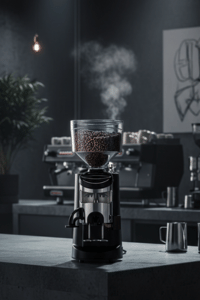
Nuova Simonelli MDXS Coffee Grinder – Commercial Espresso Grinder
The Nuova Simonelli MDXS coffee grinder is a commercial espresso grinder built for precision and consistency. With a large bean hopper and professional-grade performance, it’s designed for coffee shops that require reliable dosing and efficient grinding during busy service hours.
Our Pick: Real commercial build, real service network, honest startup price.
The base MDXS is the most honest budget recommendation in this lineup. NSF-certified, built for cafe use, 75mm flat burrs, backed by the full Simonelli US service network.
This is a real commercial grinder, not a prosumer machine dressed up for cafe use.
On-demand grinding means it doses directly into the portafilter on request, keeping workflow clean during rush.
If your staff is experienced and can manage manual calibration without digital preset support, this machine at $1,350 is an excellent value.
The honest tradeoff vs the Digit: no programmable presets, no digital display. Recalibration when you switch bags requires more barista attention.
For a stable, well-trained team, this is no problem. For high-turnover staff, it becomes a daily training issue.
Buy it if
Don’t buy it if
4. Baratza Forte AP Coffee Grinder— Best Decaf / Backup Grinder
$850 Aprox | Up to 150 shots/day

Baratza Forte AP Coffee Grinder – Commercial Flat Burr Grinder
The Baratza Forte AP coffee grinder is a commercial flat burr grinder designed for precision and versatility. Featuring a digital touchscreen display and durable construction, it delivers consistent grinding for espresso and brew methods, making it a reliable choice for specialty coffee shops and professional bar setups.
Our Pick: Perfect as a dedicated decaf station or backup. The best compact commercial option in this list.
The Forte AP is the right tool for a specific job, and that job is not being your primary high-volume espresso grinder.
What it is: the best compact option for a dedicated decaf station, a low-volume single origin offering, or a backup grinder when your primary goes down.
54mm ceramic flat burrs grind up to 5 lbs per day, roughly 150 espresso shots. The grind-by-weight feature (accurate to ±0.2g) is genuinely impressive at this price.
The touchscreen is clean, and 260 grind settings give you real precision across espresso and all brew methods.
Baratza’s US support is legendary. Parts are widely available, the repair program is excellent, and their documentation is better than almost any grinder brand in the industry.
Buy it if
Don’t buy it if
5. TIMEMORE Sculptor 078S Coffee Grinder — Best for Specialty / Single Origin
$800 Aprox | Under 100 shots/day
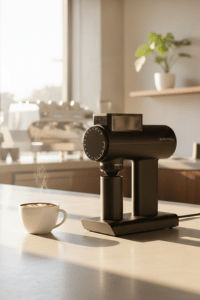
TIMEMORE Sculptor 078S Coffee Grinder – Precision Electric Grinder
The TIMEMORE Sculptor 078S coffee grinder is a precision electric grinder designed for consistency and control. With a modern, compact design and powerful burr system, it delivers uniform grind quality for espresso and manual brew methods, making it a strong choice for serious home baristas and specialty coffee enthusiasts.
Our Pick: 78mm flat burrs, stepless adjustment, exceptional grind quality for the price. Best for specialty-focused low-volume operations.
At $800 — just $50 less than the Forte AP, these two are priced almost identically, but they serve very different purposes. The TIMEMORE is a precision prosumer grinder built for grind quality above everything else.
Those 78mm flat burrs produce exceptional particle uniformity, which is exactly what you want when showcasing a single origin or a delicate pour-over alongside your espresso program.
The Forte AP is your decaf workhorse. The TIMEMORE is your specialty showpiece. Different tools, different jobs.
Where I wouldn’t use it: as your primary espresso grinder in a cafe doing 150+ shots daily. The motor is not rated for sustained high-volume commercial use.
Buy it if
Don’t buy it if
6. Fiorenzato AllGround Sense Coffee Grinder — Approach with Caution
$1,250 Aprox
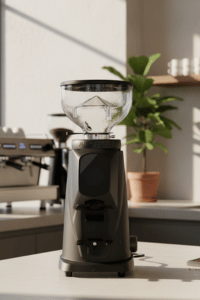
Fiorenzato AllGround Sense Coffee Grinder – Precision Electric Burr Grinder
The Fiorenzato AllGround Sense coffee grinder is a precision electric burr grinder designed for accuracy and consistency. Featuring a modern build and advanced grind control, it delivers uniform results for espresso and brew methods, making it a versatile option for home baristas and specialty coffee enthusiasts.
Fiorenzato is a legitimate Italian brand with commercial products in its lineup, but the AllGround Sense listed on Amazon is their residential line.
At $1,250, you can get the Eureka Helios 75 ($1,399) or the base Simonelli MDXS ($1,350), both purpose-built commercial grinders with established US service networks and better track records in cafe use.
The 3.4-star rating and “residential” label in the product title are flags I can’t overlook when recommending equipment a cafe owner depends on every morning.
Buy it if
Don’t buy it if
Complete Grinder + Espresso Machine Setups by Budget
Grinders should be budgeted alongside your espresso machine — not as an afterthought. Check your https://byflorr.com/essential-equipment-list-for-coffee-shop-startups before committing to numbers.
| Setup | Grinder + Machine | Best For |
|---|---|---|
| $12,000 Starter | MDXS ($1,350) + Appia II (~$8,990) + install + filter | New cafes under 200 shots/day |
| $15,000 Mid Setup | MDXS Digit ($1,850) + Forte AP decaf ($850) + Appia II | 150-300 shots/day with decaf |
| $20,000+ Full Setup | Helios 75 ($1,399) + MDXS decaf ($1,350) + mid-range machine | 250-300 shots/day established cafe |
Keeping Your Grinder Running
Daily: Purge with a few grams before service, wipe the hopper, empty the grounds bin.
Weekly: Deep clean with Grindz tablets, brush down burrs, check your calibration.
Every 3-6 months: Replace burrs ($80–$200 depending on brand), full disassembly clean.
Burrs dull gradually, you won’t notice until shots start tasting flat. Mark replacement dates on a calendar now. A $150 burr set is far cheaper than losing regulars to inconsistent espresso.
Grinder upkeep belongs on your daily coffee shop operations checklist right alongside machine maintenance.
My Final Take
| Best Overall | Nuova Simonelli MDXS Digit ($1,850 Aprox) — programmable, 75mm burrs, Simonelli network |
| Best Value | Eureka Helios 75 ($1,399 Aprox) — touchscreen, stepless, solid mid-range commercial |
| Best Budget Commercial | Nuova Simonelli MDXS ($1,350Aprox) — real commercial build, lowest Simonelli price |
| Best Decaf / Backup | Baratza Forte AP ($850 Aprox) — grind by weight, 260 settings, legendary support |
| Best Specialty / Single Origin | TIMEMORE Sculptor 078S ($800 Aprox) — 78mm burrs, exceptional quality for the price |
| Approach with Caution | Fiorenzato AllGround Sense ($1,250 Aprox) — residential rated, choose Helios 75 instead |
The right commercial coffee grinder isn’t the most expensive one. It’s the one that matches your shot volume, produces consistent doses across every barista shift, and fits your actual budget.
The grinder is where extraction really starts. After 150+ cafe visits, the best-tasting shots I’ve seen have consistently come from shops that invested in the grinder as seriously as in the machine.
Ready to complete your setup? The full commercial espresso machines guide covers the best machine pairings for every grinder on this list.
Opening soon? I help coffee shops with Google My Business optimization and Local SEO for successful soft openings. Contact me →
Own a coffee shop? See how you compare.
Explore real coffee shops applying the strategies you just learned—then add your café to the directory to get discovered by customers searching by location.
Related Guides:
- https://byflorr.com/commercial-espresso-machines
- https://byflorr.com/essential-equipment-list-for-coffee-shop-startups
- https://byflorr.com/buy-or-lease-an-espresso-machine
- https://byflorr.com/coffee-shop-profit-margins
Frequently Asked Questions About Commercial Coffee Grinders
How much does a commercial coffee grinder cost?
Commercial coffee grinders cost $800–$1,850 for the machines in this guide.
Plan on $1,350–$1,850 for a solid mid-range grinder for most small cafes doing 150-300 shots daily. Budget separately for a second decaf grinder, even a $850 Forte AP covers that job well.
Do I need two grinders for my coffee shop?
Yes, if you serve decaf. Switching a single grinder between espresso and decaf wastes 3-5 minutes of purging time and produces inconsistent shots until the grinder re-seasons.
A dedicated decaf grinder pays for itself quickly in saved time and reduced coffee waste.
What’s the difference between timed and gravimetric dosing?
Timed dosing grinds for a set number of seconds, simple but requires recalibration every time you switch coffee bags. Gravimetric dosing weighs each dose automatically and adjusts accordingly.
More consistent across different coffees and staff shifts. Worth the premium if you have rotating baristas or a specialty program.
How often should I replace the burrs on a commercial grinder?
Every 500–1,000 lbs of coffee ground, depending on the grinder. For a cafe doing 200 shots daily, roughly 8 lbs of coffee, that’s every 6-9 months.
Budget $80–$200 per burr set. Dull burrs produce flat, inconsistent espresso gradually, so mark your replacement dates on a calendar now.
Can I use a home grinder in my coffee shop?
No. Home grinders aren’t built for commercial volume and will fail quickly. They also won’t pass health department inspection, most jurisdictions require NSF-certified commercial equipment for licensed cafe operation.
Always buy commercial from day one.
What grinder pairs best with the Nuova Simonelli Appia II?
The Nuova Simonelli MDXS Digit is the natural pairing, same brand, same service network, same level of reliability.
For a more budget-conscious setup, the Eureka Helios 75 at $1,399 is an excellent match that won’t bottleneck the machine.
Check the full https://byflorr.com/commercial-espresso-machines guide for complete pairing recommendations.
Should I buy or lease a commercial coffee grinder?
Most cafes should buy outright. Unlike espresso machines ($8,000–$12,000), a solid commercial grinder costs $1,350–$1,850, manageable as a direct purchase. Leasing rarely makes financial sense at this price point.
The exception is if a roaster offers a grinder bundled with a coffee supply contract; read those agreements carefully before signing.
How do I know when my burrs need replacing?
The most common sign is shots that taste flat or sour even when your recipe hasn’t changed. You may also notice your grind time increasing to hit the same dose weight.
If you’re recalibrating more often than usual, that’s another signal. Don’t wait for obvious failure, preventive replacement keeps your cup quality consistent.