The best commercial espresso machines for small coffee shops in 2026 are the Nuova Simonelli Appia II 2-Group ($8,990), Rancilio Classe 7 ($9,500+), and Nuova Simonelli Appia II 3-Group ($11,695).
Which one you should buy depends on your daily shot volume, budget, and local service access.
I’ve been in over 150 coffee shops from NYC to Portland. I’ve seen every mistake: owners who blow $15,000 on a machine they don’t need, or buy a $3,000 model that dies in 18 months.
The best commercial espresso machines aren’t the most expensive; they’re the ones that show up every morning without failing.
Here’s what matters: Can it pull 200+ shots without breaking? Will it fit your counter? Can you get it fixed when it breaks at 8am on Saturday?
This guide covers seven machines I’ve observed handling real café volume. No showroom BS, just what works when you’re building your coffee shop business plan.
“Feeling overwhelmed by the paperwork? Let’s work together on your NYC coffee shop marketing so you can focus on opening your doors.”
Explore the coffee directory
Want to see how real coffee shops turn these strategies into sales?
Quick Comparison: Best Commercial Espresso Machines
[Insert visual comparison table here]
| Machine | Price | Daily Volume | Why Buy It |
|---|---|---|---|
| Nuova Simonelli Appia II | $8,990 Aprox | 250-350 shots | Never breaks |
| La Marzocco Linea Classic | $12,000+ Aprox | 250-350 shots | Industry standard, 15-year lifespan |
| Nuova Simonelli Appia II 3-Group | $11,695+ Aprox | 400-500 shots | Growth option, same reliability |
| Victoria Arduino Eagle One | $18,450+ Aprox | 300+ shots | Has an app (actually useful) |
| Rocket R9 V | $9,500 Aprox | 200-280 shots | Instagram gold |
| Synesso MVP Hydra | $24,500+ Aprox | 300+ shots | For coffee nerds with budgets |
| Rancilio Classe 7 | $9,500+ Aprox | 250-320 shots | Boring, bulletproof |
What Makes These the Best Commercial Espresso Machines
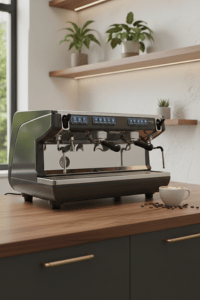
Nuova Simonelli Appia II Espresso Machine for Professional Coffee Bars
This is the Honda Civic of commercial espresso machines. Not sexy, but it starts every morning.
26 inches wide fits almost anywhere. Service is cheap, every tech knows Simonelli inside out.
The best commercial espresso machines survive three things: morning rush, tiny spaces, and your local water quality.
I’ve watched an $8,990 Nuova Simonelli outlast two $18,450+ boutique machines because the owner could get same-day service. Meanwhile, a beautiful Italian machine sat broken for five days waiting for a tech from New Jersey.
Here’s what the best commercial espresso machines do:
- Pull 200-300 shots daily without complaining
- Fit in 24-30 inches of counter (most small cafes)
- Have technicians who answer their phones
- Meet NSF certification (health department requirement)
I focus on small shops, not Starbucks, not your home kitchen. These are commercial espresso machines that work in real 800-square-foot cafes with two baristas and a line out the door.
Before investing in any of these machines, make sure you’ve factored them into your complete coffee shop startup costs.
How to Pick Your Commercial Espresso Machine

Nuova Simonelli Appia II 3-Group Espresso Machine
Same bulletproof Appia II reliability, but with a third group head for high-volume operations.
1. Do the Math First
Calculate: Daily customers × 65% × 1.7 shots per drink
Reality check:
- 150-200 shots/day: You can start small
- 200-300 shots/day: You need a solid 2-group (most cafes land here)
- 300+ shots/day: Get high-capacity or consider 3-group
Don’t cheap out based on week one projections. A cafe I worked with hit 250 shots daily by month three. Their $4,500 machine couldn’t keep up. Expensive lesson.
2. Measure Your Bar
Standard 2-group commercial espresso machines are 24-30″ wide. Measure before you fall in love.
One Brooklyn cafe ordered a machine without measuring. Couldn’t fit it on their bar. Had to rebuild the entire counter. Cost them $3,200 and two weeks of delays.
Leave 6 inches on each side for maintenance. Trust me on this.
3. Check Your Electrical
Most commercial espresso machines need 220V / 30-40 amps. Upgrading runs $2,000-$5,000 depending on your building’s age.
Pro tip: Call an electrician BEFORE you order. Three clients delayed their openings 2-3 weeks because they didn’t verify capacity first.
4. Real Budget Numbers
4. Real Budget Numbers
Machine prices for commercial espresso machines:
- Entry: $8,500-$10,000
- Mid-range: $10,000-$15,000
- Premium: $15,000-$25,000+
Don’t forget:
- Installation: $500-$1,500
- Water filter: $300-$800
- Commercial grinder: $1,200-$3,500 (seriously, don’t cheap out here)
- Annual service: $800-$1,200
Your grinder matters as much as your machine. I’ve seen $8,000 commercial espresso machines make mediocre shots because the owner paired it with a $400 grinder.
Check our essential coffee shop equipment guide for the complete setup.
5. Service Access (This Is Everything)

Before buying any commercial espresso machine, call local techs:
- Do they service this brand?
- What’s their response time?
- What do they charge?
When your machine dies during Saturday rush, waiting three days costs you $2,000-$5,000 in lost revenue. I’ve seen it happen.
Good service networks for commercial espresso machines:
- La Marzocco (everywhere)
- Nuova Simonelli (everywhere)
- Synesso (growing)
- Victoria Arduino (Simonelli network)
- Rancilio (techs know them blind)
6. Water Quality Matters
Hard water kills commercial espresso machines. Check your local water report.
- Hard water areas (Southwest, Midwest): Budget $500-$1,000 for serious filtration
- Soft water areas (Pacific Northwest, Northeast): $300-$500 standard filter works
Ideal TDS: 75-150 ppm. Outside that range? You’ll need more filtration.
Commercial vs Semi-Commercial: What You Actually Need
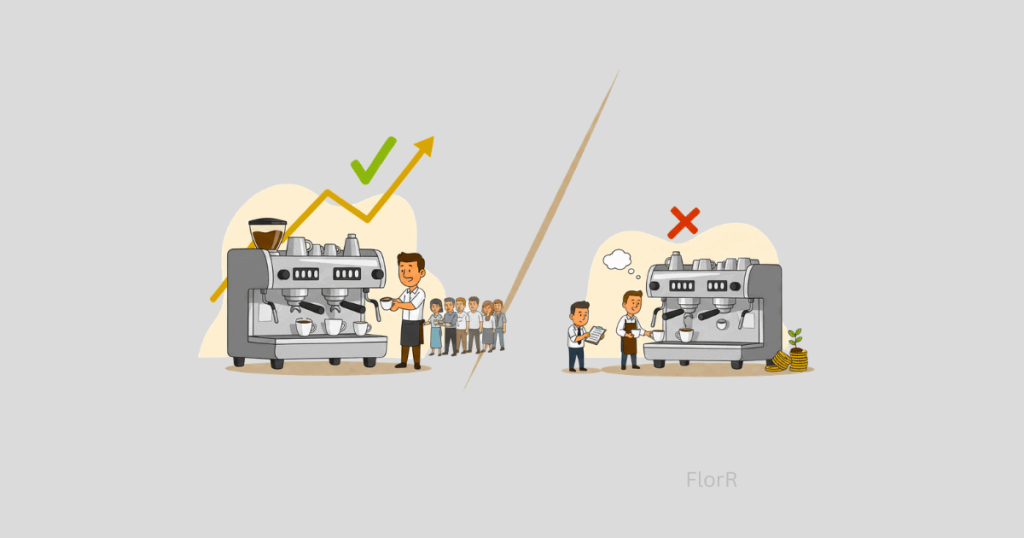
Real commercial espresso machines:
- NSF certified (required for licensing)
- Built for 200+ shots/day
- Last 10-15 years
- $5,000-$20,000
Semi-commercial (prosumer):
- Built for 50-150 shots/day
- $3,000-$7,000
- May not pass health inspection
- Last 5-8 years
Health department requirements vary by state. Some places are strict, some flexible. Always check before buying prosumer for commercial use.
My advice: Even if you’re starting small, buy commercial. Growth happens fast. Don’t outgrow your machine in six months.
The 7 Best Commercial Espresso Machines
1. Nuova Simonelli Appia II – The Workhorse
$8,990 Aprox | 250-350 shots/day
Nuova Simonelli Appia II Espresso Machine for Professional Coffee Bars
This is the Honda Civic of commercial espresso machines. Not sexy, but it starts every morning.
26 inches wide fits almost anywhere. Service is cheap, every tech knows Simonelli inside out.
Why I recommend it:
I’ve seen these run for 11 years straight. One cafe in Williamsburg does 320 shots on Saturdays; this machine doesn’t blink. The steam power is incredible (two 20oz pitchers simultaneously, no pressure drop).
The downside:
It looks industrial. If your cafe’s aesthetic is Instagram-first, this isn’t your machine.
Buy it if
Don’t buy it if
Disclosure: These are affiliate links. You pay the same price, and we earn a small commission that helps us create guides like this.
2. La Marzocco Linea Classic – The Industry Standard
$12,000+ Aprox | 250-350 shots/day
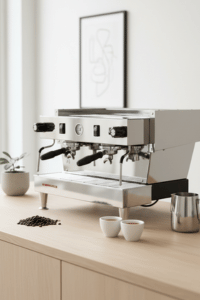
La Marzocco Linea Classic Espresso Machine
This is what you see in every serious specialty café. There’s a reason.
Why it works:
Saturated group heads keep temperature rock-solid, ±0.5°F. A dual boiler means steam and brew never compete. PID control on each group lets you dial in different coffees simultaneously.
Built in Italy, engineered to last 15+ years. One café in Brooklyn has had the same Linea Classic running since 2009, still pulls perfect shots. La Marzocco’s service network is the best in the industry. Call them Saturday morning, they answer.
The catch:
You’re paying a premium price for premium quality. At $12,000+, it’s $3,000 more than the Nuova Simonelli Appia II, though both will serve you well for years.
Buy it if
Don’t buy it if
3. Nuova Simonelli Appia II 3-Group – The Growth Machine
$11,695 | 400-500 shots/day
Nuova Simonelli Appia II 3-Group Espresso Machine
Same bulletproof Appia II reliability, but with a third group head for high-volume operations.
Why you’d buy this:
You’re opening in a high-traffic location or your business plan projects rapid growth. Three group heads mean three baristas can pull shots simultaneously during Saturday morning rush without waiting.
The extra capacity matters when you hit 350+ shots daily. One café in Midtown Manhattan started with a 2-group, outgrew it in 8 months, and had to upgrade.
Cost them $15K total (selling used machine at a loss + buying new). Better to buy right the first time.
The tradeoff:
You’re paying $2,700 more than the 2-group version, and it needs more counter space (approximately 35-40 inches wide). Most small cafés don’t need this capacity on day one.
Buy it if
Don’t buy it if
Where to buy:
Includes free espresso starter kit and 3M water filtration system.
4. Victoria Arduino Eagle One – The Tech Machine
$$18,450+ Aprox | 300+ shots/day
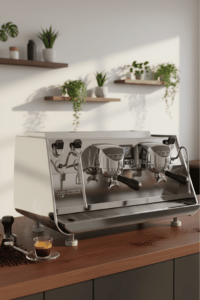
Victoria Arduino Eagle One Espresso Machine
This commercial espresso machine has an app. Sounds gimmicky, it’s not.
What’s cool:
Monitor remotely, track temperature data, schedule maintenance. T3 technology = three independent temperature systems. One Tribeca shop showed me six months of consistency data: never varied more than 0.3°F.
Steam four pitchers back-to-back without pressure loss. It’s gorgeous, with its stainless steel and copper construction that customers photograph constantly.
The reality:
You’re paying $18K+ for features most cafes won’t use. If you’re not tracking extraction data and rotating single origins, save your money.
Buy it if
Don’t buy it if
5. Rocket R9 V – The Pretty One
$14,100+ Aprox | 200-280 shots/day

Rocket R9 V Espresso Machine
Hand-built in Milan. Mirror-polished steel, exposed copper boilers. This is jewelry.
Why it’s popular:
Customers Instagram it constantly. One Nolita owner said it generates more social media content than anything else in the shop. Low profile (16.5″ tall) fits under-counter setups.
The tradeoff:
You’re paying a premium for aesthetics. Service network is smaller—expect slightly longer wait times in smaller cities.
Buy it if
Don’t buy it if
6. Synesso MVP Hydra – The Pro Tool
$24,500+ Aprox | 300+ shots/day
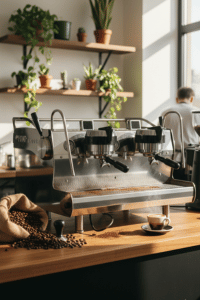
Synesso MVP Hydra Espresso Machine
Real-time pressure profiling. Competition baristas love this thing.
What it does:
Paddle control lets you adjust pressure mid-shot. Start at 2 bars pre-infusion, ramp to 9, taper at the end. Totally changes the extraction for single origins.
Build quality is insane, engineered in Seattle like a precision instrument.
Hard truth:
These capabilities are wasted if your baristas don’t understand extraction science. I’ve seen $24K+ Hydras operated exactly like $9K machines because nobody was trained.
Buy it if
Don’t buy it if
7. Rancilio Classe 7 – The Reliable Boring One
$9,500+ Aprox | 250-320 shots/day

Rancilio Classe 7 – A Reliable Espresso Machine for Busy Cafés
This machine is boring. That’s why it works.
What owners say:
“It just works. Every day. For 10 years.” I’ve seen Rancilio commercial espresso machines that are 12 years old still pulling shifts in high-volume cafes.
Service network is massive, small cities and rural areas have Rancilio techs. Parts are cheap and available.
The downside:
Looks utilitarian. It won’t win any design awards.
Buy it if
Don’t buy it if
Complete Espresso Bar Setups by Budget
Complete Espresso Bar Setups by Budget
Understanding total costs helps you plan better. Here’s what complete setups look like at different price points:
$18,000 Total Budget (Basic Setup)
- Nuova Simonelli Appia II: $8,990
- Mahlkonig E65S Grinder: $2,400
- Water filtration system: $500
- Professional installation: $800
- Subtotal: $12,690
- Remaining for POS, furniture, etc: $5,310
Best for: Cafes doing 250-300 shots daily, espresso-only menu (no decaf)
$28,000 Total Budget (Complete Setup)
- Nuova Simonelli Appia II: $8,990
- Two grinders (espresso + decaf): $4,200
- Premium water filtration: $1,200
- Professional installation + electrical: $1,500
- Subtotal: $15,890
- Remaining buffer: $12,110
Best for: Cafes doing 250-300 shots daily, offering both regular and decaf without switching
$40,000 Total Budget (Premium Setup)
- La Marzocco Linea Classic: $12,000
- Premium grinder setup (two grinders): $5,500
- Advanced water system: $2,000
- Full professional installation: $2,500
- Subtotal: $22,000
- Remaining for operations: $18,000
Best for: Quality-focused specialty cafes doing 300+ shots daily
These numbers assume you still need to budget for your coffee shop POS system, refrigeration, and other equipment from your complete equipment list.
Keeping Your Commercial Espresso Machine Alive

Daily (5 minutes):
- Backflush at close
- Wipe steam wands after every use
- Empty drip trays
Weekly (30 minutes):
- Backflush with Cafiza
- Soak portafilter baskets
- Deep clean steam wands
Monthly:
Get a pro in. Water testing, gasket checks, calibration. Budget $800-$1,200 annually.
Preventive maintenance is 10x cheaper than Saturday morning emergency repairs. I’ve watched this lesson cost owners $3,000+ in lost weekend revenue.
These maintenance practices are part of your overall daily coffee shop operations that keep your business running smoothly.
📍 Regional Considerations for Commercial Espresso Machines
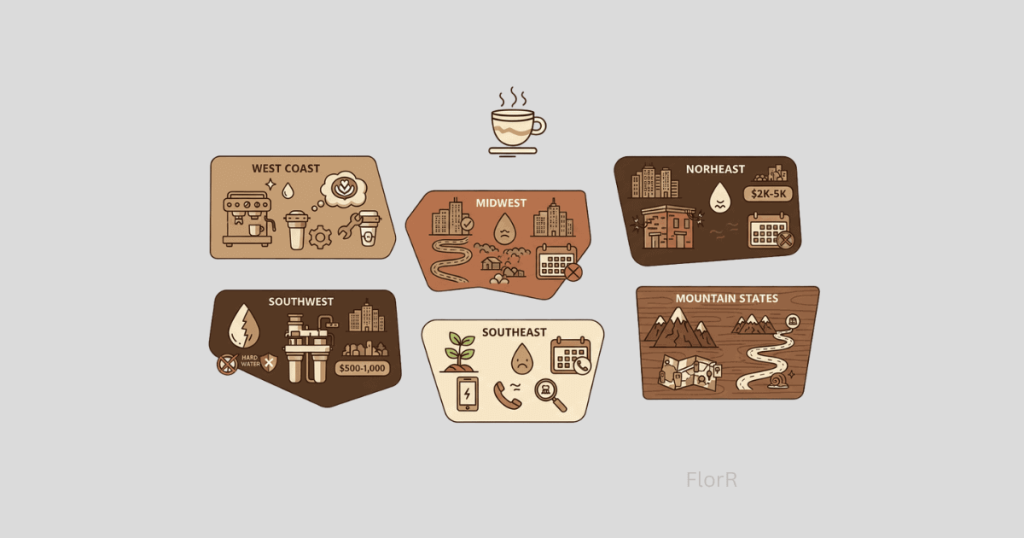
Location dramatically affects which commercial espresso machines work best:
West Coast:
- Soft water (good for machines)
- High coffee expectations
- Excellent service networks
- Budget: Standard $300-500 filtration
Southwest:
- HARD WATER (biggest challenge)
- Budget $500-$1,000 for serious filtration
- Verify service in smaller markets
- Water quality can void warranties
Midwest:
- Moderate water quality
- Good service in cities
- Limited options in rural areas
- Plan for potential service delays
Northeast:
- Great service networks in cities
- Older buildings may need electrical upgrades
- Soft to moderate water
- Budget extra $2K-5K for electrical in historic buildings
Southeast:
- Growing specialty coffee scene
- Improving service networks
- Moderate water quality
- Verify tech availability before buying
Mountain States:
- Hard water (filtration critical)
- Limited service outside Denver/Boise/Salt Lake
- Plan for longer service response times
- Consider brands with broader networks
Frequently Asked Questions About the Best Commercial Espresso Machines
How much does a commercial espresso machine cost?
Commercial espresso machines cost $8,500-$25,000+ for the machine itself.
Total espresso bar investment, including installation ($500-$1,500), water filtration ($300-$800), and commercial grinder ($1,200-$3,500) runs $14,000-$35,000. Budget $800-$1,200 annually for professional maintenance.
What size commercial espresso machine do I need for a small coffee shop?
Calculate: (daily customers × 65% ordering espresso × 1.7 shots per drink). Most small cafes need 2-group commercial espresso machines rated for 200-300 shots daily.
Buy based on your 12-month projection, successful cafes often outgrow machines quickly.
Should I buy or lease a commercial espresso machine?
Lease if cash preservation matters (typical payments: $150-$400/month).
Buy if you have reserves and want a lower total cost. Leasing makes sense for most startups despite the higher total cost, and it preserves working capital for unexpected expenses during your first year.
How long do commercial espresso machines last?
The best commercial espresso machines last 10-15 years with proper maintenance. Key factors: daily cleaning, weekly deep cleaning, monthly professional service, water quality management.
Neglected machines fail in 3-5 years; well-maintained machines run 15+ years.
Do commercial espresso machines need 220V electrical service?
Most 2-group commercial espresso machines require 220V with 30-40 amp dedicated circuits. Some smaller commercial models offer 110V options, but typically sacrifice steam power and may not handle high volume as well.
Verify electrical capacity and budget for upgrades before purchasing commercial espresso machines.
What’s the difference between heat exchanger and dual boiler commercial espresso machines?
Heat Exchange (HX) machines use a single boiler with heat exchanger, cost less ($4,000-$7,000), and may have minor temperature fluctuations.
Dual boiler machines have separate brew and steam boilers, provide superior temperature stability, and cost more ($6,000-$12,000+). For 200+ daily shots, the dual boiler delivers better consistency.
Can I use a home espresso machine in my coffee shop?
No. Home machines aren’t NSF-certified like true commercial espresso machines, can’t handle commercial volume, void warranties when used commercially, and will fail quickly.
Health departments require NSF-certified commercial espresso machines for licensed cafe operation.
Which brands make the most reliable commercial espresso machines?
Based on cafe owner feedback and service technician input, the most reliable brands are:
La Marzocco (exceptional build quality), Nuova Simonelli (workhorse reliability), Synesso (premium tier), Victoria Arduino (Simonelli Group), and Rancilio (proven 10-15 year track record). All have established US service networks.
How important is local service availability for commercial espresso machines?
Critical. When your commercial espresso machine fails during Saturday morning rush, waiting 3-5 days costs $2,000-$5,000+ in lost revenue.
Before purchasing, verify: authorized technicians in your area, typical service response times, parts availability, and service call rates. Don’t assume service, call and confirm.
What’s the best commercial espresso machine for a beginner cafe owner?
For first-time cafe owners, the Nuova Simonelli Appia II ($8,990) or La Marzocco Linea Classic ($12,000+) are the best commercial espresso machines.
Both offer excellent reliability, widespread service networks, and proven track records. The Appia prioritizes value and ease of service; the Linea Classic prioritizes shot quality and brand prestige.
My Final Take on the Best Commercial Espresso Machines
My Final Take on the Best Commercial Espresso Machines
Best overall: Nuova Simonelli Appia II 2-Group ($8,990) – Bulletproof reliability, serviced everywhere
Best value: Rancilio Classe 7 ($9,500+) – Boring, reliable, proven 10-15 year track record
Best for quality: La Marzocco Linea Classic ($12,000+) – Industry standard, 15-year lifespan
Best for design: Rocket R9 V ($14,100+) – Gorgeous aesthetics, solid performance
Pick based on priorities: budget (Appia or Rancilio), quality (Linea Classic), design (Rocket).
The right commercial espresso machine isn’t the most expensive one—it’s the one that matches your volume, fits your space, has local service, and fits your actual (not fantasy) budget.
Before you buy any commercial espresso machine:
- Calculate 12-month shot volume honestly
- Measure your bar space precisely
- Verify electrical capacity with licensed electrician
- Check local water quality report
- Confirm local service availability (call, don’t assume)
- Set realistic total budget (machine + grinder + installation + filtration)
- Visit cafes running the machines you’re considering
Growing up in Peru’s coffee country taught me one thing: equipment lasts when you maintain it religiously.
After 150+ cafe visits, I’ve learned the best commercial espresso machine is the one that shows up every morning, not the one with the longest spec sheet.
Ready to complete your equipment setup? Check our complete guide on how much it costs to open a coffee shop to budget for everything beyond just the espresso machine.
Opening soon? I help coffee shops with Google My Business optimization and Local SEO for successful soft openings. Contact me →
Own a coffee shop? See how you compare.
Explore real coffee shops applying the strategies you just learned—then add your café to the directory to get discovered by customers searching by location.
Related Guides:
Daily Coffee Shop Operations Checklist
Essential Equipment List for Coffee Shop Startups