This site contains affiliate links. I may earn a commission if you purchase through these links. Thank you for being so supportive!
You’re working 60-hour weeks. Your café is packed every morning. Customers love your coffee.
So why does your bank account look like you’re barely surviving?
Understanding coffee shop profit margins is the difference between running a coffee business that pays your bills and one that drains your savings.
Most café owners focus on revenue, or how much money comes in. But profit margins? That’s what actually matters.
Here’s the brutal truth: You can have a line out the door and still lose money if your margins are off. A café doing $30,000 monthly with healthy margins makes more profit than one doing $50,000 with terrible margins.
Coffee shop profit margins tell you how much money you actually keep after paying for everything: beans, milk, rent, labor, and equipment. It’s the number that determines whether your café is a sustainable business or an expensive hobby.
Ready to understand where your money actually goes and how to keep more of it?
Let’s break down coffee shop profit margins in plain language, show you what’s normal, and give you specific ways to improve yours.
Explore the coffee directory
Want to see how real coffee shops turn these strategies into sales?
What Are Coffee Shop Profit Margins (And Why They Matter More Than Revenue)

Coffee shop profit margins measure how much profit you make for every dollar of sales. It’s calculated as:
Profit Margin = (Net Profit ÷ Total Revenue) × 100
If you make $10,000 in sales and have $8,000 in expenses, your net profit is $2,000. That’s a 20% profit margin.
Sounds simple, right? But here’s where it gets tricky.

V60 Coffee Maker
COFFEE SCALE

CHEMEX
Three Types of Profit Margins You Need to Track
Gross Profit Margin: Revenue minus cost of goods sold (COGS)—just your coffee, milk, cups, lids, food. Doesn’t include rent, labor, or utilities.
Operating Profit Margin: Gross profit minus operating expenses—rent, labor, utilities, marketing. This shows how efficiently you run day-to-day operations.
Net Profit Margin: What’s left after everything—taxes, loan payments, depreciation. This is your actual take-home reality.
Most café owners only track revenue. “We did $40K this month!” Okay, but did you profit $400 or $4,000? That’s the difference between struggling and thriving.
Industry Benchmarks: What’s Normal for Coffee Shop Profit Margins

Let’s talk real numbers. According to industry data and conversations with dozens of café owners, here’s what typical coffee shop profit margins look like:
Average Coffee Shop Profit Margins by Type
Independent Coffee Shops:
- Gross Profit Margin: 60-70%
- Operating Profit Margin: 10-15%
- Net Profit Margin: 2.5-6%
Specialty/Third-Wave Cafés:
- Gross Profit Margin: 65-75%
- Operating Profit Margin: 12-18%
- Net Profit Margin: 5-10%
Coffee Shops with Full Food Programs:
- Gross Profit Margin: 55-65%
- Operating Profit Margin: 8-12%
- Net Profit Margin: 2-5%
Drive-Through Coffee Stands:
- Gross Profit Margin: 70-80%
- Operating Profit Margin: 15-25%
- Net Profit Margin: 10-15%
See the pattern? Drive-through stands have the highest coffee shop profit margins because they have lower rent and labor costs.
Full-service cafés with food have lower margins because food costs more and spoils faster than coffee.

cOFFEE HOODIES

COFFEE T-SHIRTS

EMBROIDERY
Why 2.5% Net Profit Margin Isn’t a Failure
New café owners panic when they hear “2.5% net profit margin.” On $30,000 monthly revenue, that’s only $750 profit.
But context matters. Restaurants average 3-5% net margins. Retail stores average 5-7%. Coffee shops fall right in line with other food service businesses.
The real question isn’t “Is 2.5% good?” It’s “Can you survive on 2.5%?” If you’re doing $500,000 annually, 2.5% is $12,500 profit. That won’t support you. But 10% on that same revenue? That’s $50,000, now we’re talking.
Breaking Down Your Coffee Shop Profit Margins by Category

Understanding your margins means knowing where every dollar goes. Here’s the typical breakdown for a healthy café:
Cost of Goods Sold (COGS): 25-35% of Revenue
This includes everything you sell:
- Coffee beans: 8-12%
- Milk and dairy alternatives: 6-10%
- Cups, lids, sleeves, straws: 3-5%
- Food (if applicable): 8-12%
- Syrups, sweeteners, extras: 2-3%
Target COGS for coffee shops: 28-32%
If your COGS is above 35%, you’re either overpouring, wasting product, or pricing too low.
One café owner discovered their baristas were making 20-ounce lattes in 16-ounce cups, giving away 4 ounces of milk on every drink. That extra milk cost them $400 monthly.

Commercial Coffee Brewers

commercial Blenders
CHEMEX for your Café
Labor Costs: 30-40% of Revenue
Labor is typically your biggest expense after COGS:
- Barista wages and tips
- Management salaries
- Payroll taxes
- Workers’ compensation insurance
Target labor costs for coffee shops: 30-35%
Above 40%? You’re overstaffed or inefficient. Below 25%? You’re probably understaffed, which hurts service quality and increases barista burnout.
Smart scheduling makes a huge difference. One café reduced labor from 38% to 32% just by adjusting shift overlap and cross-training staff to handle multiple stations.
Occupancy Costs: 8-15% of Revenue
Your physical location expenses:
- Rent or mortgage
- Property insurance
- Property taxes
- Common area maintenance (CAM) fees
Target occupancy costs: 10-12%
The old retail rule is “rent should be 10% of revenue.” If you’re paying $3,000/month rent, you need $30,000 monthly revenue minimum. Anything higher and occupancy is eating your coffee shop profit margins.
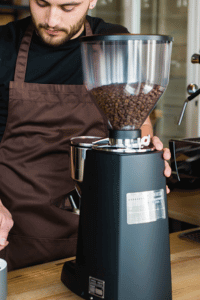
High-Output Commercial Coffee Grinder – Barista-Grade Consistency
Equip your café with a commercial grinder engineered for speed, consistency, and nonstop service. Designed for high-volume coffee shops that need precise grind size, powerful motors, and reliable performance every day. Explore top grinders trusted by professionals.
Operating Expenses: 10-15% of Revenue
Everything else to keep doors open:
- Utilities (electric, water, gas): 3-4%
- Equipment maintenance: 1-2%
- Marketing and advertising: 2-3%
- Supplies and smallwares: 1-2%
- Insurance (liability, equipment): 1-2%
- Credit card processing fees: 2-3%
These seem small individually, but they add up fast. Credit card fees alone can eat 2.5-3% of revenue if you’re not negotiating rates.
Where Coffee Shop Profit Margins Leak (Common Problems)

Even successful cafés lose money in predictable places. Here’s where coffee shop profit margins typically leak:
Problem #1: Waste and Overpouring
Baristas free-pouring shots, adding extra pumps of syrup, or steaming too much milk destroys margins. If each barista wastes $5 daily in product, that’s $150 monthly per employee.
The fix: Standardize recipes. Use pumps for syrups. Train on proper portioning. One café owner implemented shot timers and reduced coffee waste by 15%.
Problem #2: Theft and “Freebies”
Staff giving free drinks to friends. Taking home pastries at end of shift without paying. “Accidentally” ringing things up wrong.
Industry estimates suggest 2-3% of revenue disappears to employee theft in food service.
The fix: Clear policies. Point-of-sale systems that track discounts. Regular inventory counts. Cameras (not to spy, but to deter).
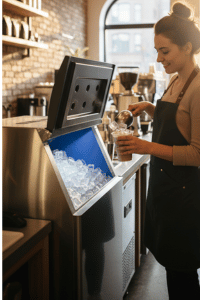
Commercial Ice Machine for Coffee Shops – High-Capacity Ice Production
Keep your café running smoothly with a commercial ice machine designed for high-demand beverage service. Fast production, dependable performance, and built for daily café operations. Explore top-rated models perfect for iced coffees, cold brews, and blended drinks.
Problem #3: Menu Items That Lose Money
That fancy seasonal drink with six ingredients? It might cost $3.50 to make but sells for $6. After labor and overhead, you’re barely breaking even.
Blended drinks are notorious margin killers; they tie up equipment, take longer to make, and use expensive ingredients.
The fix: Calculate actual cost for every menu item. Price strategically. Eliminate or reprice items with margins below 60%.
Problem #4: Inefficient Labor Scheduling
Three baristas working during a slow Tuesday afternoon. Only one person during Saturday morning rush.
Poor scheduling creates two problems: overstaffing (high labor costs) and understaffing (slow service, lost sales).
The fix: Track sales by hour for 2-3 weeks. Schedule based on actual traffic patterns. Use overlapping shifts during transitions.

Commercial Under-Counter Fridge – Built for Daily Coffee Shop Operations
Optimize your coffee shop with a commercial under-counter refrigerator designed for speed, efficiency, and tight spaces. Perfect for milk, syrups, and quick-access ingredients. Built for busy cafés that need reliable cooling all day. Explore top-rated models made for professional service.
Problem #5: Ignoring Small Expenses
$50 here for rush delivery. $75 there for emergency repair. $100 for that marketing thing that didn’t work.
These “small” expenses add up to thousands annually. Death by a thousand cuts.
The fix: Track every expense. Review monthly. Question everything. Just because you’ve “always done it” doesn’t mean you should keep doing it.
How to Improve Your Coffee Shop Profit Margins

Improving coffee shop profit margins isn’t about one big change. It’s about multiple small improvements that compound.
Strategy #1: Increase Prices Strategically
A $0.25 increase on a latte that sells 100 times daily generates $750 monthly in pure profit. Customers rarely notice small, strategic price increases.
Test increases on high-volume items first. Raise prices 5-10% on specialty drinks. Most customers won’t balk at $6.25 vs. $6.00.
Strategy #2: Improve Your Product Mix
Not all products have equal margins:
- Drip coffee: 85-90% margin
- Espresso drinks: 75-80% margin
- Blended drinks: 65-70% margin
- Food items: 60-70% margin
Selling more drip coffee improves overall margins. Use menu engineering to highlight high-margin items. Train baristas to upsell strategically.
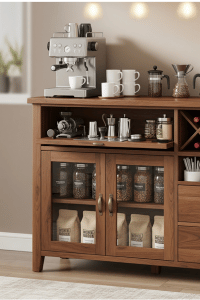
Modern Coffee Shop Furniture
Contemporary coffee shop furniture is designed for style and comfort. Create an inviting, elegant space where customers can relax, connect, and enjoy every cup in a modern atmosphere.
Strategy #3: Reduce COGS Through Better Purchasing
Negotiate with suppliers. Buy in bulk (when it makes sense). Switch to local bakeries that deliver, often cheaper than national suppliers.
One café switched milk suppliers and saved $180 monthly without changing quality. Over a year, that’s $2,160 in pure profit.
Strategy #4: Optimize Labor Without Hurting Service
Cross-train staff so one person can handle the register and bar during slow times. Use technology, mobile ordering reduces register bottlenecks during rush.
Pay attention to prep work. Can some tasks happen during slow periods instead of during rush? Shift schedules save money without reducing headcount.
Strategy #5: Track Everything Obsessively
You can’t improve what you don’t measure. Weekly inventory counts. Daily sales reports. Monthly profit and loss statements.
Successful café owners know their numbers cold. They can tell you their busiest hour, best-selling drink, and highest-margin item without checking spreadsheets.

HIGH TABLE
With Stools

LONG TABLE
With Stools
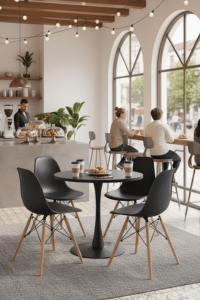
BLACK TABLE
With Chairs
Key Takeaways
- Coffee shop profit margins average 2.5-6% net, 10-15% operating, and 60-70% gross for independent cafés
- COGS should be 28-32%, labor 30-35%, occupancy 10-12%
- Profit margins vary by café type—drive-throughs have highest, full-service lowest
- Small leaks (waste, theft, inefficiency) compound into big losses
- Improving margins requires multiple small changes: pricing, product mix, purchasing, labor, and tracking
Final Thoughts
Understanding coffee shop profit margins transforms how you run your business. You stop chasing revenue and start protecting profit.
A café doing $25,000 monthly with 8% net margins ($2,000 profit) is healthier than one doing $40,000 with 2% margins ($800 profit). The first owner takes home more money working fewer hours.
Start tracking your numbers this week. Calculate your actual margins. Identify your biggest leaks. Make one improvement this month.
Your coffee shop’s profit margins determine whether you build a sustainable business or burn out trying to make a broken model work. Focus on margins, and revenue will follow.
Own a coffee shop? See how you compare.
Explore real coffee shops applying the strategies you just learned—then add your café to the directory to get discovered by customers searching by location.
FAQs
What is a good profit margin for a coffee shop?
A healthy coffee shop profit margin ranges from 5-10% net profit, 12-18% operating profit, and 65-75% gross profit.
New cafés often start at 2-3% net profit while building their customer base. If you’re consistently below 2%, something needs to change: pricing, costs, or efficiency.
Why are coffee shop profit margins so low?
Coffee shop profit margins are low because of high fixed costs (rent, labor, utilities) combined with competitive pricing.
Labor typically eats 30-40% of revenue, rent another 10-15%, and product costs 25-35%. That leaves only 10-30% for all other expenses plus profit.
How can I increase my coffee shop profit margins?
Increase coffee shop profit margins by:
raising prices strategically, reducing waste through standardized recipes, optimizing labor scheduling, negotiating with suppliers, focusing on high-margin items like drip coffee, and tracking all expenses obsessively.
Small improvements compound into significant margin gains.
What’s the difference between gross and net profit margin?
Gross profit margin is revenue minus cost of goods sold (just product costs). Net profit margin is what’s left after all expenses, rent, labor, utilities, taxes, everything.
Gross margins show product profitability. Net margins show actual business profitability.
Do coffee shops with food have better profit margins?
No, coffee shops with food typically have lower profit margins (2-5% net) than coffee-only cafés (5-10% net).
Food has higher costs, more waste, and requires additional labor and equipment. However, food can increase total revenue and customer spending per visit.
How long before a coffee shop becomes profitable?
Most coffee shops take 12-18 months to become profitable as they build their customer base and optimize operations.
Break-even typically happens around months 6-9 if you’ve capitalized properly. Expect to operate at low or negative margins initially while establishing your café.
What costs hurt coffee shop profit margins the most?
Labor (30-40% of revenue) and rent (10-15%) are the biggest margin killers. After that, product costs (25-35%) and waste from overpouring, theft, and spoilage significantly impact margins.
Poor pricing and inefficient operations compound these issues.