This site contains affiliate links. I may earn a commission if you purchase through these links. Thank you for being so supportive!
You found a spot with tons of people walking by. The rent seems okay. It’s available now. You’re ready to sign.
Stop.
High foot traffic doesn’t mean anything if those people don’t want coffee at that exact location. The best coffee shop location strategy isn’t about counting bodies; it’s about understanding where your customers already spend their time.
Picking your location is the biggest decision you’ll make for your coffee business. Get your coffee shop location strategy right, and customers will find you before your espresso machine arrives.
Get it wrong, and even world-class lattes won’t save you.
Let’s break down the coffee shop location strategy that actually works.
Explore the coffee directory
Want to see how real coffee shops turn these strategies into sales?
The Smart Coffee Shop Location Strategy: Start with Anchor Businesses

Here’s the secret most owners miss: you don’t need foot traffic. You need anchor businesses.
Anchor businesses bring your ideal customers to the area every single day. They do the heavy lifting of getting people near your door. You just need to convert them into coffee buyers.
This is the foundation of any winning coffee shop location strategy.
Gyms Create Loyal Regulars
Gym members visit 3-5 times per week. They’re creatures of habit. Once they add your coffee to their post-workout routine, they’re yours.
What makes gyms great anchors:
- Members need protein coffee and cold brew after workouts
- Early morning classes (5am-7am) drive morning traffic
- Boutique studios (yoga, Pilates, CrossFit) build tight communities
- Located within 1-2 blocks walking distance
Beyond two blocks? They’ll drive home instead of stopping.
Menu considerations: Stock protein-enhanced coffee drinks, smoothies, healthy breakfast options, and grab-and-go items. Gym-goers rarely sit—optimize for speed. Learn more about optimizing your coffee shop menu for different customer types.

V60 Coffee Maker
COFFEE SCALE

CHEMEX
Office Buildings Are Revenue Machines
A 200-person office means 50-100 potential daily customers with predictable schedules. They need morning coffee, afternoon energy, and meeting spaces.
What to look for:
- At least 100 employees per building
- Within 5 minutes walking from main entrance
- No competing coffee already in the lobby
Office workers pay premium prices for speed. They buy bulk orders for meetings. They visit daily. Building strong relationships with office clients is a key part of your overall coffee shop marketing strategy.
Universities Work (But Have Risks)
Students create all-day traffic and need affordable coffee with study-friendly spaces, outlets, and Wi-Fi.
The catch: Summer and winter breaks kill revenue for 3 months. Your coffee shop location strategy needs to account for seasonal gaps.
Best university locations:
- Schools with 1,000+ enrollment
- Main campus walking routes
- Near libraries, popular buildings, or dorms

cOFFEE HOODIES
COFFEE T-SHIRTS
EMBROIDERY
Other Strong Anchors
- Hospitals: Staff need caffeine during long shifts
- Shopping centers: Shoppers take coffee breaks
- Transit stations: Commuters grab coffee on the go
- Medical offices: Visitors kill time while waiting
Weak anchors to avoid:
- Pure residential areas where people brew at home
- Industrial zones empty after 5pm
- Tourist attractions dead in the off-season
Download my free Coffee Shop Location Scorecard with the exact checklist, revenue calculator, and anchor business analysis I use with clients.
The Rent Calculation Every Owner Needs

Your rent must stay under 10-15% of monthly revenue. Period.
Most failed coffee shops ignored this rule. They asked, “Can I afford $5,000 monthly?” instead of “Can this location generate $50,000 monthly to support $5,000 rent?”
Smart coffee shop location strategy always starts with revenue projections, then calculates affordable rent. Understanding your coffee shop’s profit margins is essential before committing to any lease.
Calculate Realistic Revenue
Step 1: Count potential customers
- Office workers within 5-minute walk
- Residents within 10-minute walk
- Gym members or students nearby
Step 2: Estimate capture rate
- Competitive area: 5-10% try you
- Underserved area: 15-25% try you
- Unique concept: 20-30% try you
Step 3: Average transaction value
- Quick service: $6-8
- Specialty coffee: $8-12
- Full menu: $12-18

Commercial Coffee Brewers

commercial Blenders
CHEMEX for your Café
Real example:
- 500 office workers nearby
- 20% capture = 100 customers
- 3 visits weekly per person
- 60 daily transactions (100 × 3 ÷ 5)
- $8 average sale
- $480 daily = $10,560 monthly revenue
Maximum rent: $1,056-1,584/month (10-15%)
If landlords want $3,000? Your coffee shop location strategy should be to walk away.
Negotiate Smarter Rent
Percentage rent: Lower base rent plus percentage of revenue after hitting targets. Landlord wins when you win.
Buildout allowance: Request $10-30 per square foot toward renovations. Saves your cash for equipment.
Graduated increases: Flat rent first year, modest increases (3-5%) as you grow.
Visibility and Access Matter More Than You Think

People can’t buy from coffee shops they can’t see or reach.
Visibility Essentials
Corner locations win: Visible from two streets, not one. Double your exposure.
Clear signage: Drivers need 3-5 seconds to spot your sign and decide to stop. Trees or poor placement kill impulse visits.
Big windows: Customers want to see inside before entering. Dark or blocked windows look closed.
Evening lighting: If you’re open past 5pm, light up your exterior. Dark storefronts read as closed.
Parking and Access
Urban: Skip parking if transit and walkability are strong. Add bike racks.
Suburban: Need minimum 8-10 dedicated spots with easy access.
Drive-thru: Requires space for 6-8 cars without blocking parking lot traffic.
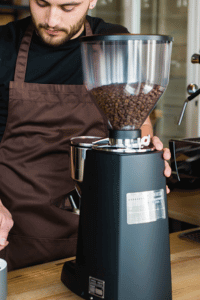
High-Output Commercial Coffee Grinder – Barista-Grade Consistency
Equip your café with a commercial grinder engineered for speed, consistency, and nonstop service. Designed for high-volume coffee shops that need precise grind size, powerful motors, and reliable performance every day. Explore top grinders trusted by professionals.
Delivery Is Part of Your Strategy Now
Apps like Uber Eats and DoorDash now bring 15-30% of coffee shop revenue. Your coffee shop location strategy must include delivery logistics as part of your overall business plan.
What Delivery Needs
Easy driver parking: Quick pickup access. If drivers circle 5 minutes, they’ll skip you.
Clear address: Visible from the street with an accurate Google Maps pin.
Dense demand: Need 10,000+ residents or offices within 1-2 miles. Beyond 3 miles, fees discourage orders.
Staging space: Dedicated counter for bagging delivery orders separate from in-house customers.
Competition: Finding the Sweet Spot

1-2 competitors nearby? Perfect. They’ve validated demand and trained customers to buy specialty coffee. Learn how to differentiate your coffee shop from nearby competition.
5+ competitors? Oversaturated. You’re fighting for scraps.
Zero competition? Warning sign. Maybe demand doesn’t exist. Research deeper.
The 7-Day Location Test
Before signing anything:
Weekdays (Mon-Fri):
- Visit at 7am, noon, 5pm
- Count foot traffic for 15 minutes
- Note demographics (students? professionals?)
- Identify anchor businesses
Weekend (Sat-Sun):
- Repeat same times
- Compare to weekday traffic
- Dead weekends = red flag
Talk to neighbors: Ask other business owners about traffic, challenges, satisfaction. They’ll reveal hidden problems.
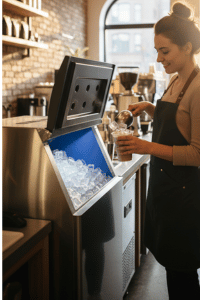
Commercial Ice Machine for Coffee Shops – High-Capacity Ice Production
Keep your café running smoothly with a commercial ice machine designed for high-demand beverage service. Fast production, dependable performance, and built for daily café operations. Explore top-rated models perfect for iced coffees, cold brews, and blended drinks.
Your Location Checklist
✅ Strong anchor businesses drive daily customer flow
✅ Rent is 10-15% or less of projected revenue
✅ Visible from multiple directions
✅ Parking or transit matches your market
✅ Delivery-friendly with driver access
✅ 1-2 competitors validate demand
✅ Lease allows buildout time
✅ Zoning and permits confirmed
The Bottom Line
Smart coffee shop location strategy isn’t about finding the busiest street. It’s about understanding where your customers already go every day and positioning yourself to intercept them.
Look for anchor businesses driving the right traffic. Calculate rent based on realistic revenue, not monthly affordability. Ensure visibility, access, and delivery logistics work.
The right coffee shop location strategy makes everything easier. The wrong location makes everything impossible, no matter how good your coffee is. This location decision is just one part of building a successful coffee business.
Ready to evaluate potential locations with confidence? Download my free Coffee Shop Location Scorecard with the exact checklist, revenue calculator, and anchor business analysis I use with clients.
Also, check out my complete guide to starting a coffee shop for more essential strategies.
The perfect location is out there. Now you have the coffee shop location strategy to find it.
Own a coffee shop? See how you compare.
Explore real coffee shops applying the strategies you just learned—then add your café to the directory to get discovered by customers searching by location.
Frequently Asked Questions
What’s the most important part of coffee shop location strategy?
Finding strong anchor businesses (gyms, offices, schools) that bring your ideal customers daily. Anchors do the hard work of driving traffic—you just convert them into buyers.
How much should rent be as percentage of revenue?
Maximum 10-15% of gross monthly revenue. Calculate realistic revenue first, then determine affordable rent. Never sign based on monthly budget alone.
Should I choose high-traffic or low-rent locations?
Neither extreme works. Choose moderate rent (10-15% of revenue) with qualified traffic from anchor businesses bringing your target customers, not just random foot traffic.
How close to anchors should my coffee shop be?
Within 1-2 blocks (5-minute walk) for offices and gyms. Adjacent (same building) for high-traffic anchors like transit. Beyond 3 blocks, benefits drop significantly.
Do I need parking for a successful coffee shop?
Urban locations with strong walkability and transit don’t need parking. Suburban and car-dependent areas require minimum 8-10 dedicated spots. Drive-thru needs space for 6-8 cars.
How do I know if my location supports delivery?
Check for 10,000+ residents or dense offices within 2-mile radius. Verify easy driver access and parking. Locations beyond 3 miles from customer density struggle with delivery orders.
Is nearby competition good or bad?
1-2 competitors prove demand exists. Zero might mean zero demand. 5+ means oversaturation. Look for 1-2 competitors as validation without fighting for scraps.
What’s minimum square footage needed?
600-800 sq ft for espresso bar with limited seating. 1,000-1,500 sq ft for full seating and food program. Under 500 sq ft only works for walk-up windows or kiosks.
How long should my coffee shop lease be?
3-5 years with 2-3 year renewal options provides stability without excessive commitment. Avoid 10-year leases as beginner—need flexibility if location underperforms.
Can residential neighborhoods support coffee shops?
Yes, if you have 5,000+ residents within a 10-minute walk and strong foot traffic. Spread-out residential areas struggle—people brew at home instead of walking for coffee.